DAIMO vs Other Facility Management Systems: How to Choose
Most vendor comparison pages are written by one of the vendors, which is why they all conclude the same way. This one is too, so here is the method up front: we state what DAIMO does, factually and checkably. For every other system we give you the question to ask its vendor rather than an answer we invented on their behalf. A comparison table that puts words in a competitor's mouth is not research, and you should not trust one whoever wrote it.
What are you actually choosing between?
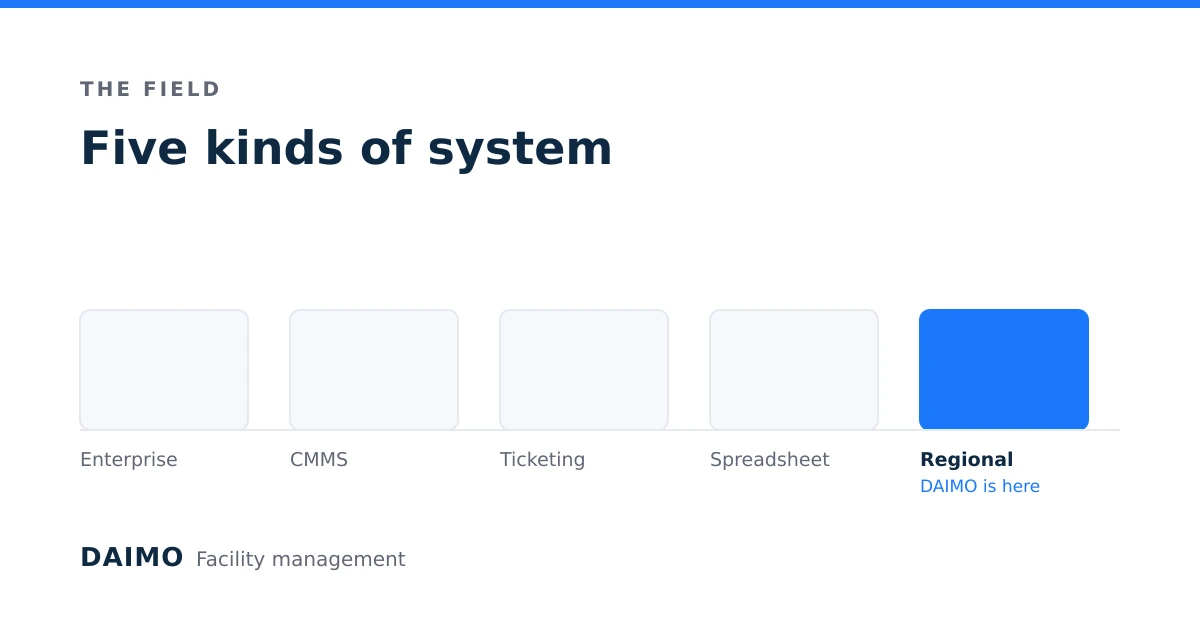
Facility management software sorts into five archetypes. Naming the archetype you are in narrows the field faster than any feature list, because the archetypes fail in different ways and at different sizes.
The global enterprise suite. Products positioned for large asset-intensive enterprises, in the category their vendors call EAM or IWMS. Very deep, built for organisations with a dedicated systems team. IBM Maximo and SAP's asset management line are the reference points here, and both companies position them that way publicly.
The maintenance-only CMMS. Focused, often excellent at work orders and preventive maintenance, deliberately narrow. Cost, space and tenant-facing services are out of scope by design.
The generic ticketing tool. A helpdesk or project tool bent into facility use. Cheap, familiar, and missing the asset register, which is the part that makes facility data worth having.
The spreadsheet. Still the most widely deployed facility management system in the world. Genuinely correct below a certain size.
The regional platform. Built for a specific market's language, working practices and regulatory context. DAIMO is in this group.
None of these is the right answer in general. The enterprise suite is the right answer for an airport authority and the wrong answer for a forty-person operations team, and the reason is the same in both cases.
How does DAIMO compare, and what should you ask everyone else?
The rows below are the dimensions that actually decide these projects. The DAIMO column is a statement of fact about the product. The last column is the question to put to any vendor, including us, and to insist on seeing rather than hearing.
| Dimension | DAIMO | Ask every vendor |
|---|---|---|
| Arabic | Built bilingual Arabic and English from the start, including right-to-left layout across tables, forms and reports | "Show me a work order, a report and an error message in Arabic, live, not in a slide" |
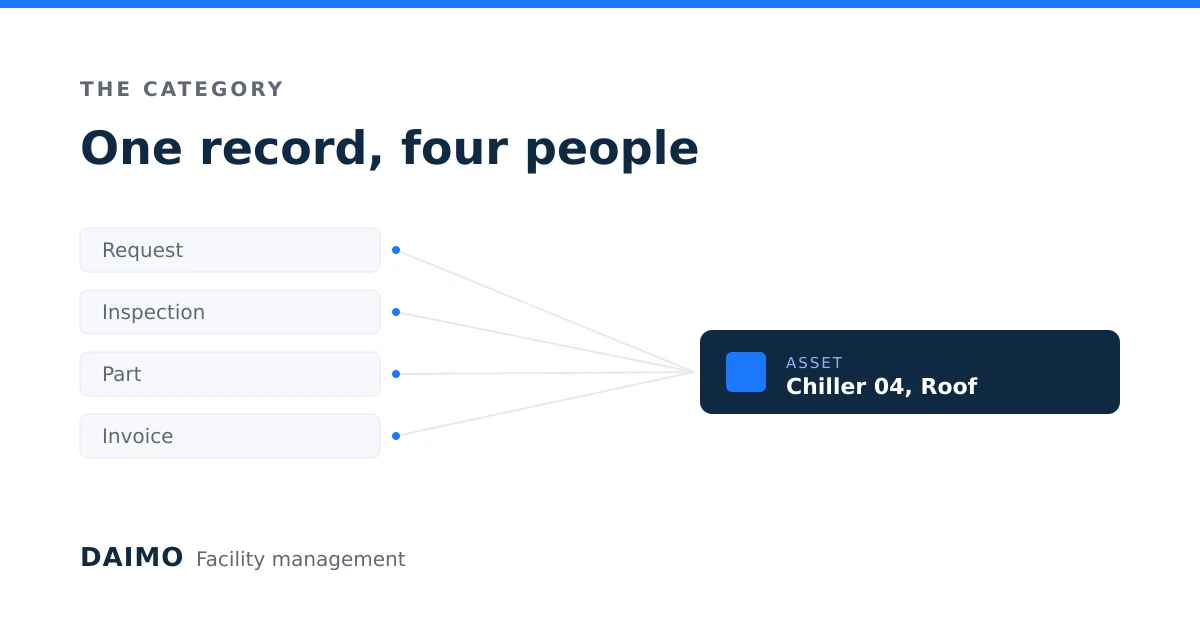
| Scope | Assets, work orders with SLA tracking, planned maintenance, multi-warehouse inventory, budgets, expenses, invoicing, approvals, analytics | "Which of these six do you not do, and what do your customers use instead?" |
| Mobile | Offline execution with sync, GPS and geofencing, time on site | "Can a technician close a job with no signal, and what happens when two people edit the same job offline?" |
| Tenancy | Multi-tenant, one subdomain per organisation, role-based access control | "How is my data separated from another customer's? Answer in one sentence I can repeat to my auditor" |
| Deployment time | Weeks, because there is nothing to install | "What is your median time to first productive use, not your fastest?" |
| Who it fits | Organisations from a few sites upward that need cost and maintenance in one record | "Name three customers my size and let me speak to one" |
| Trial | 14 days, full product | "Can I load my own asset register during the trial?" |
That last question matters more than it looks. A trial you cannot put real data into tells you about the demo, not the product.
When is DAIMO the wrong choice?
A comparison that never says this is an advertisement. Four cases where you should buy something else:
You are running a single building with two technicians. Use a spreadsheet and a group chat. You will be faster and the software will not pay for itself.
You need deep manufacturing or process-plant capability. Reliability-centred maintenance modelling, condition monitoring tied to process control, spare-part optimisation across a plant network. That is what the enterprise EAM suites are for, and they are better at it.
Your requirement is lease administration and space planning first. If the question that keeps your organisation awake is whether to renew a lease or how to plan floor occupancy, you are shopping for IWMS, and maintenance is secondary for you.
You are contractually required to use a specific platform. Some clients and master developers mandate a system. Check before you evaluate anything.
What actually differs between a regional platform and a global one?
Three things, and only one of them is language.
Language is the visible one. Bilingual and translated are different products. A translated system reverses the text and leaves the layout, so tables read the wrong way, date pickers open backwards and charts run against the page. A bilingual system reverses the layout. You can see this in thirty seconds and no amount of demo can hide it.
Working practice is the expensive one. Both Hijri and Gregorian dates appear in Saudi operations, in different documents, for different readers. Weekends are Friday and Saturday. Approval chains are often longer and more explicitly hierarchical than the defaults a European product ships with. None of this is impossible to configure in a global product. All of it is work somebody has to do and pay for.
Distance is the quiet one. When something breaks, the useful question is not where the vendor's headquarters are but what time it is there, which language the support ticket gets answered in, and how many layers sit between you and someone who can change the product. Global vendors sell through regional partners, which sometimes means excellent local service and sometimes means a reseller relaying your ticket. Ask which, and ask for the escalation path in writing.
How should you actually run the evaluation?
Most evaluations are decided by whoever gave the best demo, which is a test of the salesperson. Four steps that test the product instead:
1. Write your three reports first. Before any demo, write down the three reports you will be asked for in your first year. Make every vendor produce those three from your data during the trial. Most comparison exercises never do this and it eliminates half the field in a week.
2. Load one real site, not a sample. Take one building, load its actual assets, and run one week of actual work through each candidate. A hundred real assets tell you more than a thousand demo ones.
3. Test the Arabic with someone who was not in the sales meeting. Give an Arabic-speaking technician or coordinator twenty minutes with the system and no training. Ask them afterwards whether it reads like something written in Arabic or something translated into it. They will know immediately.
4. Ask what leaving looks like. Request a full export of your own data during the trial, and look at what comes out. A vendor confident about retention is relaxed about export. This one question is the most reliable signal in the entire process.
Common questions
Is DAIMO a CMMS or a CAFM system? CAFM. It covers work orders and preventive maintenance the way a CMMS does, and adds the cost, budget, inventory and invoicing layers that a pure CMMS leaves out. If your only requirement is maintenance, a focused CMMS may suit you better and will probably cost less.
Can DAIMO handle multiple organisations under one group? Yes. The platform is multi-tenant by design, with each organisation on its own subdomain and its own separated data, and role-based access control within each.
Does DAIMO replace an ERP? No. It costs facility work accurately and exports. Treating any facility platform as a general ledger ends badly regardless of vendor.
How does pricing compare to the global suites? Enterprise EAM and IWMS deployments are typically multi-year programmes with implementation costs that exceed licence costs, and they are priced accordingly. A regional SaaS platform is a subscription. The honest comparison is not licence against licence but total cost including the implementation work, and you should ask every vendor for both numbers separately.
What is the single best question to ask any facility software vendor? "Show me my own data in your system, in Arabic, on a phone, offline." Almost everything that matters is downstream of whether they can.